2026-10-26
Share


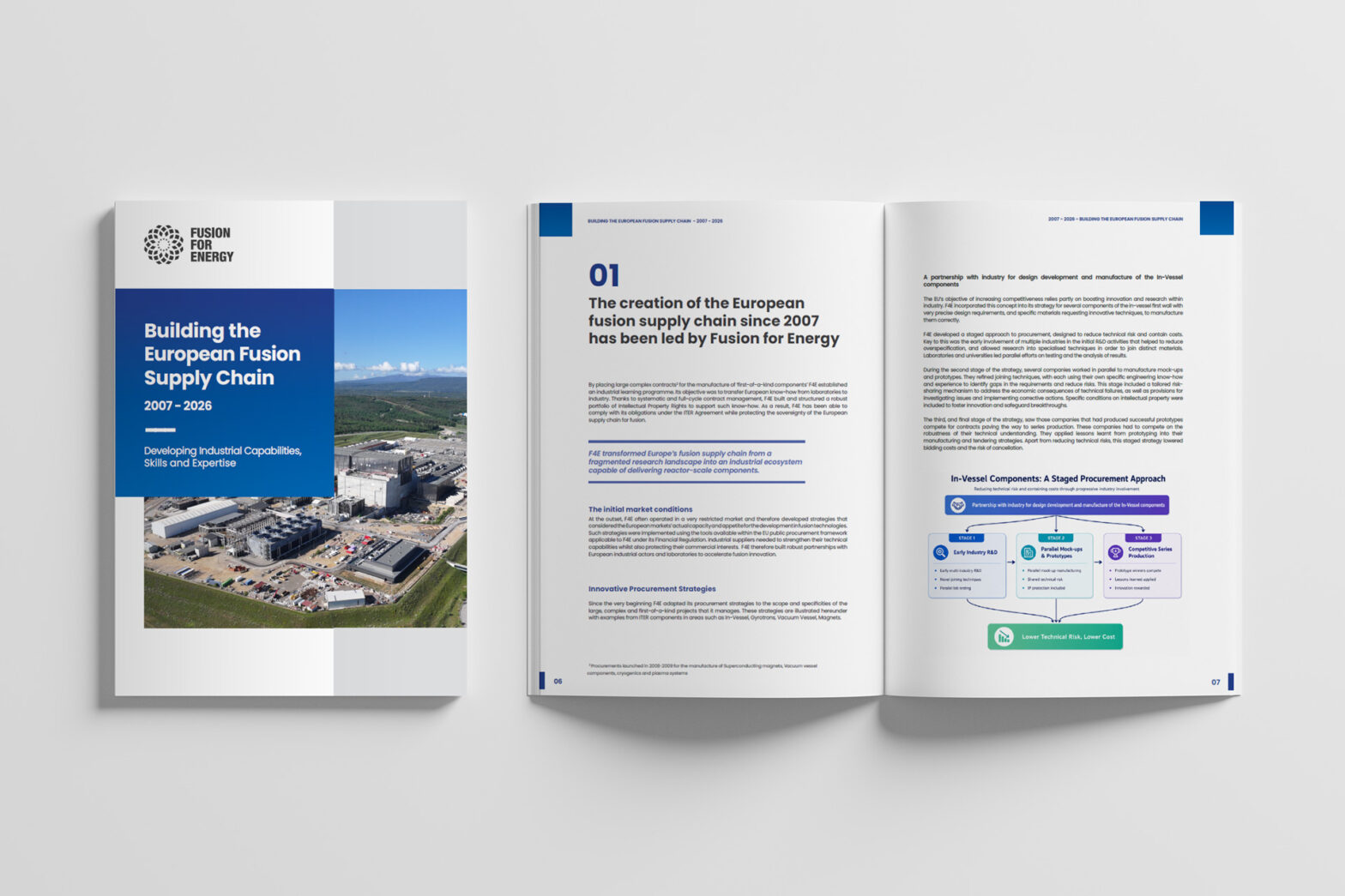
New report explains the industry’s evolution over nearly two decades.
ITER has marked a turning point in Europe’s fusion ecosystem. Over nearly two decades, F4E’s contribution to this and other projects has built a vast supply chain, essential to taking fusion technologies to the next stage.
The evolution is captured in F4E’s recently published report: Building the European Fusion Supply Chain. The publication examines how F4E’s procurement activities have helped industry to grow and explores the challenges of securing its long-term competitiveness.
“Since 2007, F4E has transformed Europe’s fragmented fusion research and industrial base into a continent-wide ecosystem capable of designing, manufacturing and delivering first-of-a-kind components for reactors,” the report starts. Today, this supply chain is the world’s largest. It counts at least 2,700 companies and 75 R&D organisations across Europe, engaged through more than 1,400 contracts with F4E.
The impact of this EU investment, totalling 7 billion EUR, goes beyond the delivery of fusion projects. It has created a ripple effect across the European economy, supporting innovation, resilience and the retention of critical know-how.
What enabled this success? The publication outlines F4E’s modus operandi, grounded in the EU public procurement rulebook and with purposed-designed strategies to support an emerging industry. Since its inception, F4E has gathered market intelligence, managed intellectual property strategically and set up agile procedures and tools. Thanks to this procurement and contract management, benchmarked against the best international standards, F4E created the conditions for strong partnerships with suppliers of all sizes.
The report also highlights ongoing initiatives to empower the supply chain. These include technology transfer instruments, collaboration frameworks with the private sector, the Technology Development Programme, and measures to facilitate the involvement of SMEs.
“The report shows how F4E has helped turn European public investment in fusion into world-class industrial capabilities. The supply chain is one of Europe’s greatest assests in fusion, and we must continue to nurture and strengthen it”, states Kristel Tans, Head of the Project Control, Supply Chain and Finance Department at F4E.