2026-09-21
Share


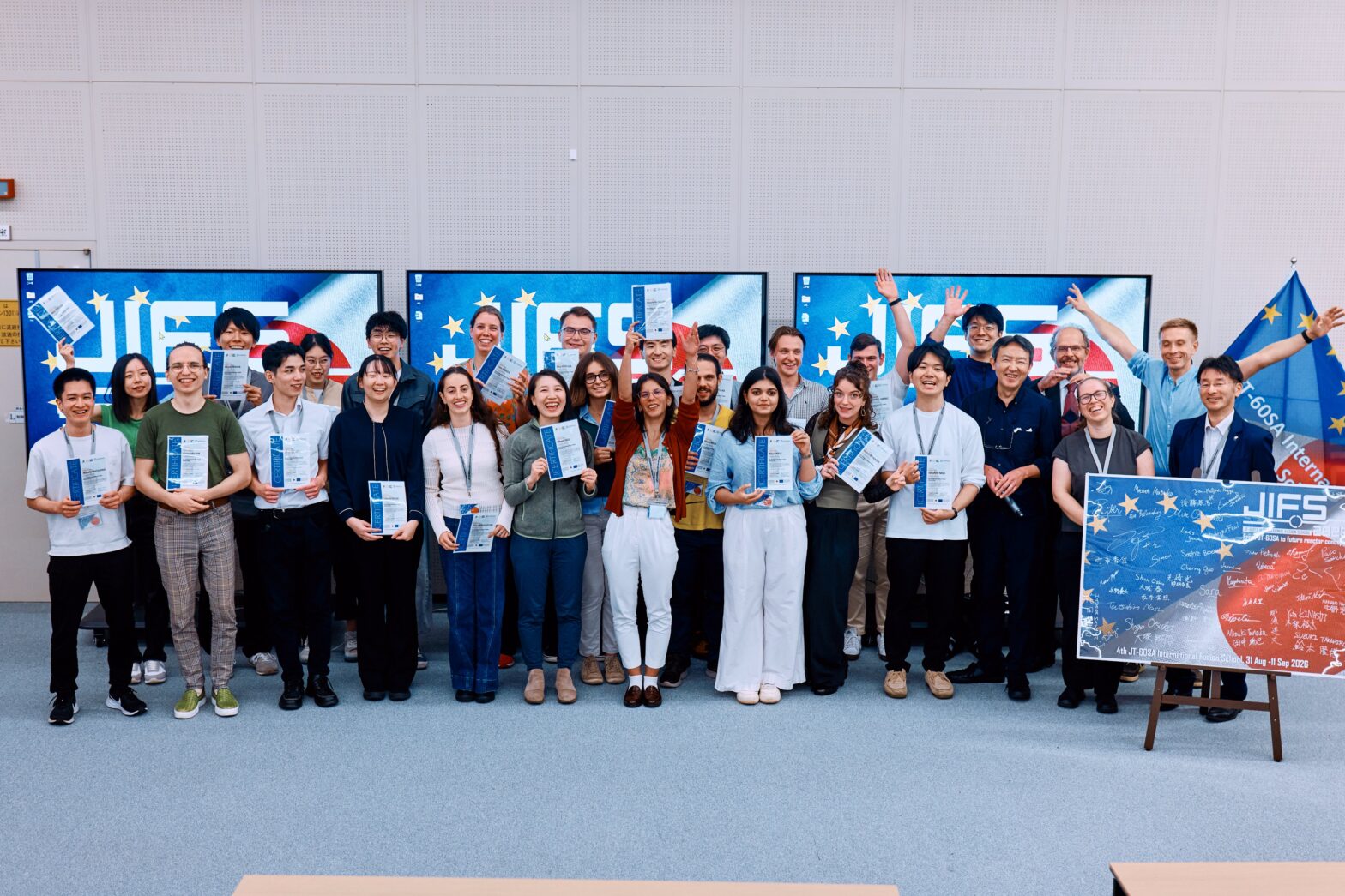
Graduation photo of the JT-60SA International Fusion School. September 2026. ©QST
There are few better places than Naka for anyone looking to dive into the world of fusion. This city north of Tokyo is home to JT-60SA, the world’s largest active tokamak. Built by Japan and Europe, the experiment will help address key scientific questions in fusion and prepare for ITER’s operations. The project also offers an opportunity to engage new generations of experts, passing the baton of knowledge to those who will shape fusion’s next chapter.
Japan’s QST and EUROfusion, with the support of Fusion for Energy (F4E), are leading two initiatives to use JT-60SA as a training ground. The first is the JT-60SA International Fusion School (JIFS), which held its fourth edition this month. 11 students from Japan and 11 from Europe came together in Naka for a two-week course, titled From JT-60SA to future reactor concepts.
The programme covered a range of topics, from tokamak design and technologies to plasma physics and operations. Participants learned directly from experts in academia, laboratories, industry or F4E. The lectures sparked lively exchanges and plenty of questions, reflecting the students’ strong preparation and interest. In addition, there were visits to the JT-60SA tokamak hall, the control room and other parts of the facility.
“JT-60SA is much more than a scientific experiment. It is a bridge between present-day fusion research and future reactors. With JIFS, we bring in the generations that will design, build, and operate them,” says Valerio Tomarchio, JT-60SA Project Manager for F4E. “We encourage our students to be curious, soak in the expertise around them and make lasting connections,” he adds.
Complementing this, QST and EUROfusion are deploying the JT-60SA Onsite Laboratory. This programme, recently extended to Europe, invites students and early-career researchers to reside at the Naka Fusion Institute and be part of the R&D activities, under the mentorship of JT-60SA experts.
Combined, JIFS and JT-60SA Onsite Laboratory form a robust pathway, from education to hands-on research. Through this integrated programme, Japan and Europe will accelerate the training of new talent capable of supporting JT-60SA, ITER and future reactors.