2026-03-24
Share


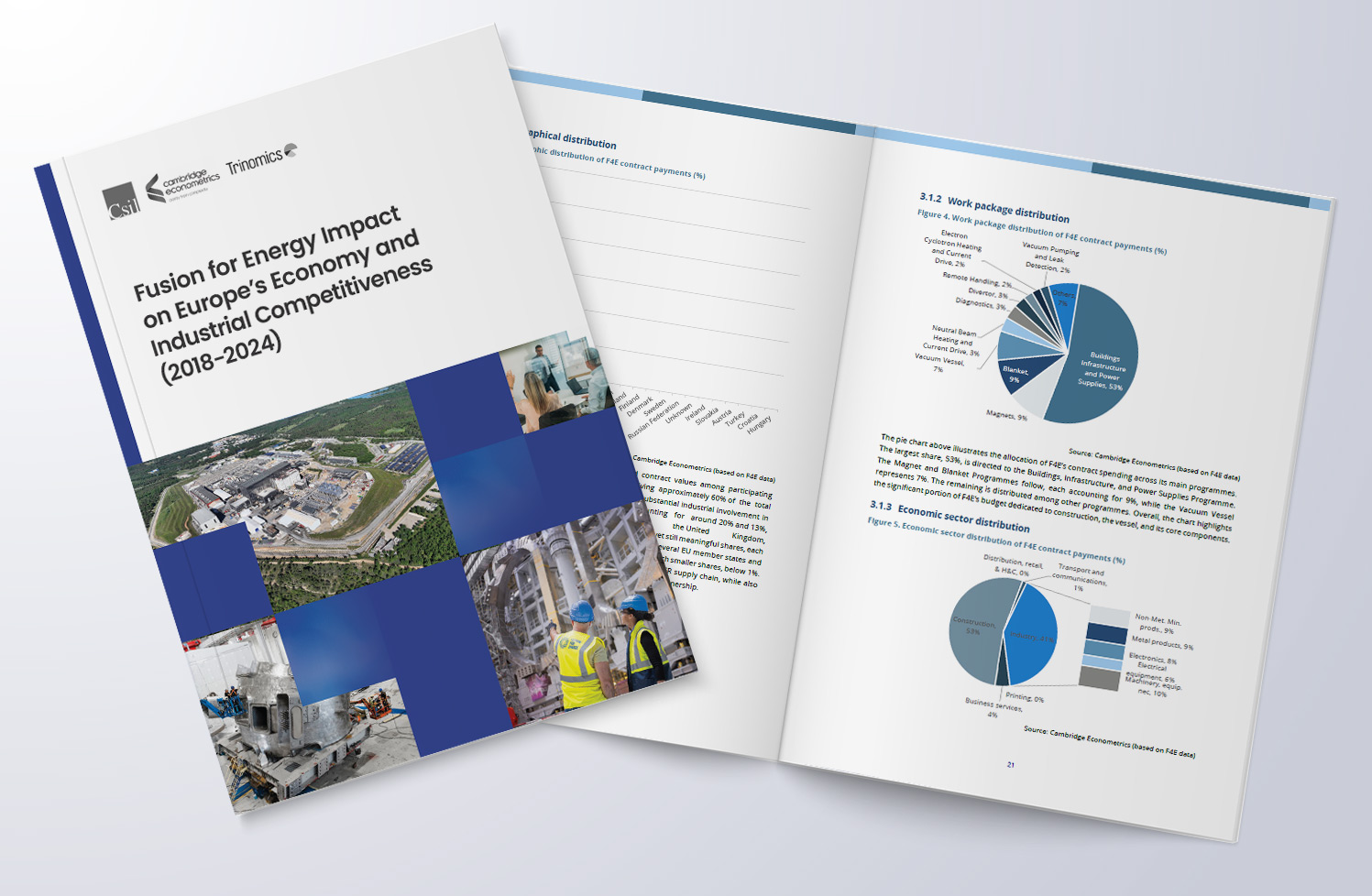
Close to 6 billion EUR of added value and 5,600 jobs per year generated in 2018-2024.
The EU’s investment in fusion creates a tremendous positive impact on Europe’s economy and industrial competitiveness. This is the main takeaway from the latest annual assessment of Fusion for Energy (F4E), an independent study conducted by the institutes CSIL, Trinomics and Cambridge Econometrics. The report highlights the ripple effect from F4E’s activities, revealing returns in knowledge, growth and jobs for the companies involved.
Since its creation in 2007, F4E has invested over 7 billion EUR to provide Europe’s contribution to ITER and other international projects through more than 1,400 contracts. This has shaped the largest supply chain in the world, with at least 2700 companies and 75 R&D organisations. Besides the infrastructure and technologies delivered, the analysis shows the far-reaching benefits resulting from these funds.
The study focuses on the period from 2018 to 2024. In this timeframe, F4E’s investment amounted to nearly 5.6 billion EUR (in 2024 prices). Such expenditure generated an estimated 5.95 billion EUR in Gross Value Added (GVA), compared with a no-spending scenario. These activities also sustained an average of 5,600 additional full-time jobs per year in the same period (a total of 39,000 job-years). Looking ahead, F4E’s contributions are expected to yield 9.88 billion EUR in GVA and 4,500 jobs per year from 2025 to 2039.
In terms of sectors, business services, industry and construction have benefited the most from these activities. This underscores how projects like ITER rely on advanced manufacturing capabilities and highly skilled services, stimulating innovation in those fields.
The researchers also surveyed a sample of companies that collaborated with F4E. Their insights highlight positive outcomes, both in technical capabilities and market position. For instance, 66% of firms reported that their staff had acquired new skills and 77% acknowledged enhanced know-how, driven by ITER’s complex requirements.
Working in fusion often results in technology breakthroughs, and with them come new business opportunities. Around half of surveyed firms noted improvements to their products or processes, with some reporting patents or spin-offs towards sectors like fission, medicine or aerospace. Many of these cases can be found on the European Fusion Technology Marketplace and its portfolio of over 130 offers.
Furthermore, suppliers experienced a boost in reputation and expanded their networks. 80% of respondents enjoy a higher visibility after working with F4E and 62% confirmed the creation of new partnerships. In addition, nearly half reported a higher turnover, with one-third increasing their customer base.