2026-10-07
Share


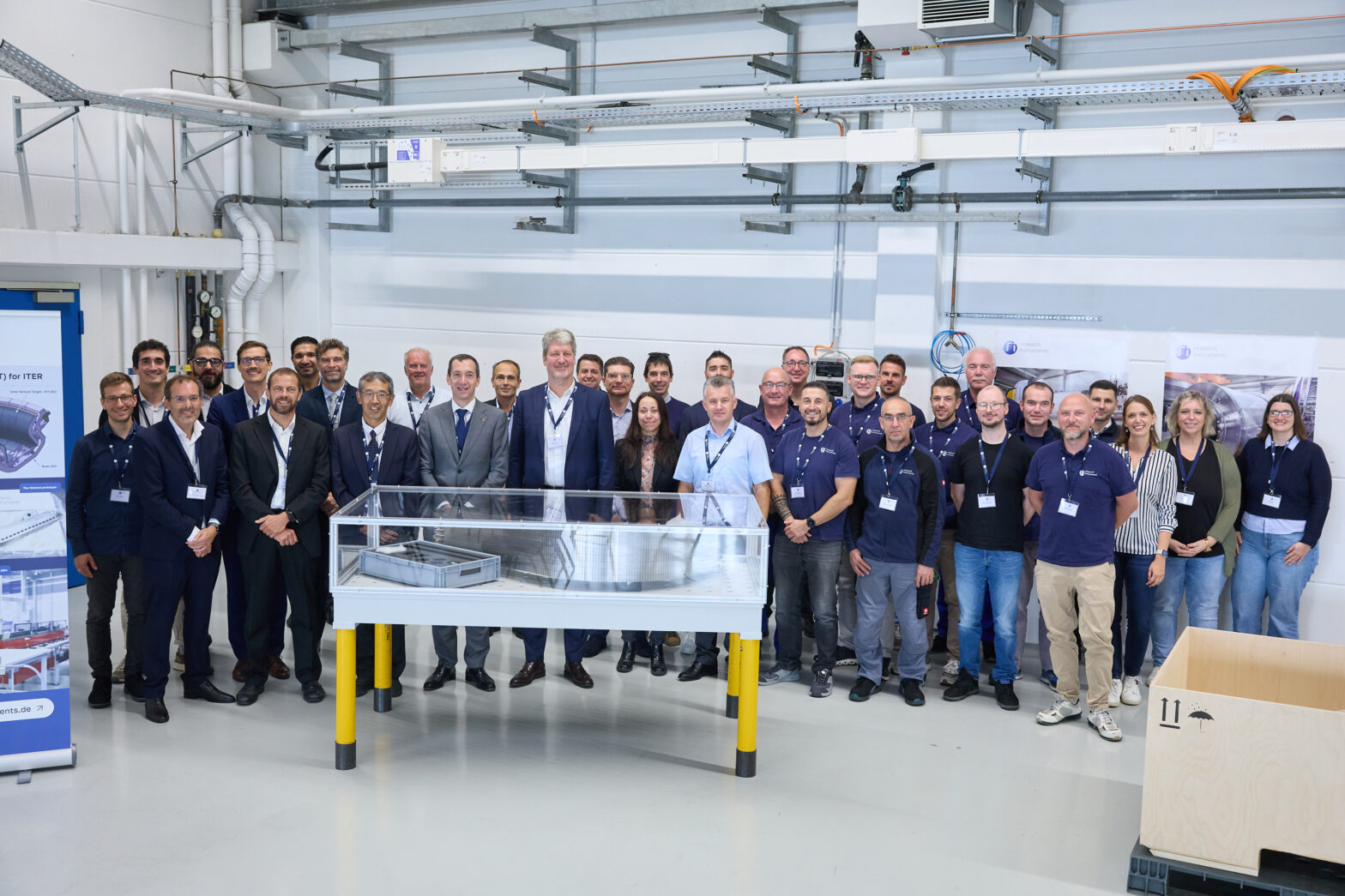
Group photo at the ceremony of completion of the first Inner Vertical Target at the RI workshop. ©Research Instruments
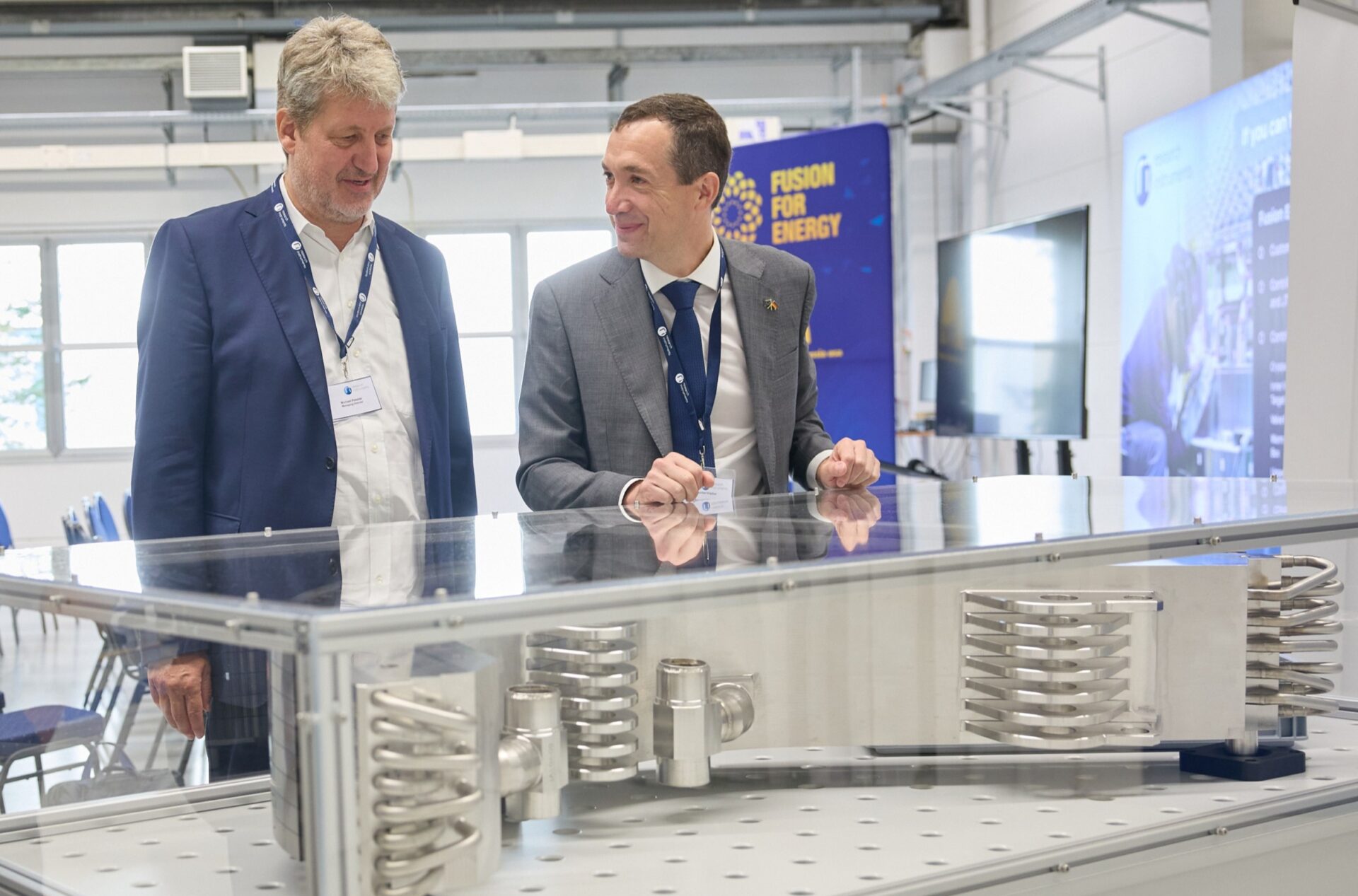
The first Inner Vertical Target (IVT) is completed and ready to face ITER’s blazing plasma. Fusion for Energy (F4E) and Research Instruments (RI) have worked together for over a decade to set the factories in motion. The component will sit at the heart of the largest-ever fusion reactor and comes with uniquely demanding requirements. Europe’s supply chain has proven it can master the challenge. Now, it must turn a hard-won first success into series production at pace.
The IVTs are part of the ITER Divertor, located at the bottom of the Vacuum Vessel and designed to extract heat and ash from the fusion reaction. The divertor is made up of 54 cassettes arranged in a circle, with three plasma-facing targets mounted on each. Their surfaces will be exposed to heat fluxes of up to 20 MW/m² —ten times more than a spacecraft re-entering Earth’s atmosphere.
Europe is responsible for providing 54 IVTs plus four spares. In 2022, F4E tasked the German company RI with the fabrication of 13 units, and later entrusted it with 15 more. In parallel, French supplier ALSYMEX is working on 13. These contracts build on years of preparatory activities, investing in new tools, optimising processes and qualifying prototypes.
The fabrication of RI’s first series unit involved an international chain of over 60 suppliers. The tasks are numerous and complex. Each IVT is covered by 2,208 blocks of tungsten, a metal with an exceptionally high melting point. The blocks are carefully machined and brazed to the cooling tubes running underneath; and later welded and assembled onto a steel structure, produced by De Pretto Industrie in Italy. Every step requires precision and skill: the IVT’s geometry leaves no room for deviation.
“The component brings together many of the challenges found in fusion manufacturing: tight tolerances, complex joints, high-performance materials, vacuum tightness, to name a few,” explains Pierre Gavila, F4E Project Manager. The teams carried out extensive tests to prove that the units can withstand ITER’s environment. This includes high heat flux tests at HELCZA, a one-of-a-kind facility in Czechia funded by F4E.
“The results were very positive, validating our engineering approaches and rewarding the investments. We have shown we can do it. Now, we need to speed up production whilst maintaining the high quality standards,” adds Gavila. The key to success, he says, will be the human factor.
Since the project’s early days, over 200 professionals from F4E, ITER Organization, RI and suppliers have worked as one team to reach this point. Many of them came together this week for a celebration at the RI workshop in Germany, attended by local and federal authorities.
“To hand over the first series IVT to F4E for ITER is a major accomplishment for RI. We are now entering the series production of this highly complex key component of ITER. We could only achieve this milestone through a close and trustful collaboration with F4E, ITER and our key suppliers Rolf Kind, ALMT, Yamato Gokin, De Pretto Industrie, and PSFU. My thanks go also to our employees, whose creativity, rigor and persistence made this success possible,” said Michael Pekeler, Managing Director of RI
“This first-ever IVT for ITER, made in Europe and manufactured in Germany, is a symbol of technological excellence and precision. F4E’s collaboration with RI will soon count 10 years. It’s a key partner that has grown with F4E’s European investment, developing infrastructure, creating jobs, and boosting the local economy,” highlighted Marc Lachaise, Director of F4E.